The #1 fear that freelancers have with paid ads?
They’re terrified of lighting money on fire and never getting it back.
I get it. It feels like a gamble that may not actually get you clients.
And if this is you, I’ve got a challenge for you that I hope will change your mind.
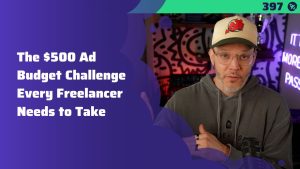
It’s called the $500 ad budget challenge.
I want to prove to you that it’s possible to turn $500 into $5k or more with paid ads, if you do it the right way.
If you’re ready to keep an open mind, listen to this week’s podcast episode where I’ll cover:
- The 3 prerequisites to running paid ads (if you have all 3 of these, you’re in a good position)
- Our “smart testing process” to squeeze all the juice out of a $500 budget
- Real stories of clients who have gotten $5k, $15k, $25k clients from less than $500 in ad spend
- How to get us to pay for your first $500 in ads
Join The Discussion In Our Community
Click here to join the discussion in our Facebook community
Click the play button below in order to listen to this episode:
Episode Links
Apply for coaching now!
Related Podcast Episodes
People and Companies
Social Media
Send Us Your Feedback!
397. 500 ad budget challenge
===
[00:00:00] the number one fear that keeps freelancers from trying out paid ads is that they're terrified of just lighting money on fire and getting nothing back.
Brian: but that's usually not the case.
Brian: So today I wanna show you exactly how to turn $500 into something meaningful for your business and when to maybe not waste any money whatsoever because maybe you're not ready for it yet. I'll talk through kind of both sides of things. And if you're actually ready for it, I'll talk you through how to get the most out of what I call this $500 strategic bet.
Brian: I'll even talk about some people we've worked with to help with their ads. Like Unique who spent, $258, she landed a $24,000 project and this was her first time ever running ads. I'll talk you through what she did and give you some examples of some others as well.
Brian: In case you're new here. I spent over a half million dollars on paid ads just last year alone, [00:01:00] 2025 alone. And we learned a ton from just doing this for our own business. But we've also coached our clients through this process like hundreds and hundreds of times.
Brian: So we've dialed in processes for testing, making sure we get the most outta every dollar we spend, making sure that we get as much of the upside as possible while mitigating as much of the downside as possible. And we've turned it into a pretty repeatable process, and I wanna share that on this episode.
Brian: If you're new here, my name's Brian Hood. I'm clearly sick right now. You know how the holidays are? You get around the little kids, they're running around everywhere, coughing on you, giving you their little, whatever diseases they have, and then you come home and you lose your voice.
Brian: Always fun stuff.
Brian: But this is the six Figure Creative podcast. It's a podcast for creative freelancers who wanna earn more money without selling their souls.
Brian: We do a lot of things here differently than a lot of other people in our niche, and I'm less on the fluffy side of things, and I'm more on the actual like, let's just talk numbers. Let's talk dollars and cents. Let's talk systems. Let processes. I take a lot of influence from other industries, like the SaaS industry is a big one that I take influence from.
Brian: So if that sounds remotely interesting, you are in the right place right now
Brian: maybe I should be sick all the time. I got the low voice, the sultry tones you're listening to Smooth Jazz 1 0 8 0.3 fm. so let's talk about this. [00:02:00] 99% of the clients that we work with when they first come to us are fully reliant on word of mouth and referrals. In order to get clients or work from their past clients, like that's the only business that they have.
Brian: They rarely, if ever, get strangers to hire them.
Brian: And when we first start working with them, we take a look at their business and we see like. Is there first any low hanging fruit that we can harvest? Is there like past clients that we can get to come back that you haven't reached out to or have you actually been following up reasonably? Do you have any past leads that you let die that actually could have been a client but you just didn't follow up properly?
Brian: Again, follow up. Is there like some people in your network that you're not tapping into properly or people that could be potential clients in your network? Are there even any neglected marketing assets like you have a large social following or YouTube following, or an email list or something that you're just not utilizing to its fullest extent in order to get clients?
Brian: So before we ever do anything in paid ads, we tap all these out and sometimes those things are enough to reach your income goals, but usually not.
Brian: When that's not enough to reach your income goals, that means you need to move to the place where pretty much everyone on earth moves, and that's getting strangers to hire you. Every business on Earth except for freelancers, for whatever reason, have accepted the fact that in order to succeed, [00:03:00] in order to thrive, strangers have to want to pay them.
Brian: Virtually every business on Earth is this way.
Brian: And while most freelancers are stuck, only working with people who already know I can trust them, they have yet to ever venture into this world of getting strangers to hire them. But when you go into that world, this is a scary place. This is new to you. You've never actually gone to the world of strangers.
Brian: Freelancers have what I call a stranger danger. But if you wanna move in the world where you're getting strangers to hire you, you basically have four choices in order to do this. First is turning, like networking into an actual viable strategy that you can deploy over and over again. It's systematizing and strategizing, networking.
Brian: Most people don't have the, network to do it. They don't know how to do it. They don't have the people skills to do it. That's usually off the table for like almost everybody if you're doing that strategically. You're probably good and you're probably not listening to this podcast, but maybe you are.
Brian: Maybe you're sick of the networking thing and you're like, this paid out thing sounds interesting. Okay, cool. Number one potential thing you could try networking, systemizing it, not just endlessly networking. Number two thing you could do is turn content marketing into a viable channel. This works for some people.
Brian: Some people are great at content marketing. They're great at social media. They're great on YouTube, [00:04:00] great on Twitter, they're great on threads. Whatever, TikTok.
Brian: This is a channel that a lot of freelancers are good at. There's something that they're comfortable with and it's something that we will help people with, if that makes sense for their skillset. However, there's a it's still the majority, 75, 80% of, freelancers, that is not their thing.
Brian: They don't have the desire to do it because it's a treadmill. It's something you have to endlessly keep churning out content. They don't have the skillset to do it because it takes a lot of charisma to do it. I don't know how I still have a podcast 'cause I don't have what it takes. and even though we have a podcast, actually paid ads are our main thing. The third option is doing endless cold outreach. Again, this is something that can work. I'd say maybe about five to 10% of freelancers I've seen attempt this have ever actually gotten a result from it. And of those have gotten a result, most of them burn out before they can keep it sustainable.
Brian: But that is a viable way of getting strangers to hire you. And the fourth kind of like main thing you can try is making paid ads work.
Brian: Here's my challenge for you on this episode. I wanna change your mind and get you to commit to a $500 paid ads test this month or next month called like a paid ads challenge. So this, in this episode, when it came out January 13th, then this is an [00:05:00] extremely good time to run paid ads. Why? Because we just got through the holidays. We just got through Black Friday. All that time is where everyone's spending tons and tons of money trying to get their bank for Christmas Day, right?
Brian: Everyone's trying to get as much money as they possibly can. After the holidays end, then January comes. The only people paying for ads right now are like fitness and health, Almost everybody, all the people that normally advertise from Black Friday period all the way through Christmas, those people stop paying ads and they start planning for the, upcoming year.
Brian: So, Ad costs plummet for all of January, all or most of February, and even in some niches into March and April. So like the first quarter of any year is the best time to do this because you're gonna get the most bang for your buck.
Brian: So I'm hoping by the end of this episode you'll be like, alright Brian, I'm gonna try this out. I'm gonna try this out I'll let you know how it goes. The downside is you lose 500 bucks and you can say, at least you give it an honest drive. This is something you've never tried before. You can at least say, I gave it an honest go, didn't work for me.
Brian: I'm moving on to something else. I'm gonna go do the endless cold outreach strategy, or I'm gonna go dance on TikTok, or [00:06:00] whatever. The realistic downside is that you spend 500 bucks and you'll at least learn something meaningful that you can utilize in future tests or somewhere else in your business.
Brian: Like some sort of actual data that you're like, oh, that's really interesting. I didn't get money back, but I got something back. So you can like keep refining for future tests, something like that. But the potential upside is really high. Thousands or tens of thousand dollars worth of projects just from the $500 test.
Brian: Let's talk about when this 500 test can work. Like I'm gonna give you three requirements that you need to have in place in order for this to work. The first is your client value has to be in the right band.
Brian: $1,500 is on the lowest end. I've seen make this work below that. It just doesn't work. $25,000 is on the higher end that I've seen work way above. That definitely doesn't work because you'd have to spend so much. So if you're between that, if your average annual client value is between 1,520 5,000, you can likely make this work.
Brian: have the first requirement done. One note on small projects. I work with a lot of music producers 'cause that's my back. And so you have a lot of clients come in, they'll record a single with you, and it'll be like 300, 500, 1200, whatever. It's under $1,500. And you're like, Brian, can I make this work?
Brian: And the answer is yes, because clients, if you do a good job with 'em, they come back to you for their [00:07:00] next single or their next EP or their next album. I'll give you a case study on this later in this episode. But those small projects add up. That's why I look at annualized value. What's an average client worth to you over the next year?
Brian: So if a client only hires you one time and that's the last time they work with you like a wedding photographer, that one. Hire is the average annual client value. If it's like a music producer and they hire you a bunch of times over the year, you look at all the projects added up on average.
Brian: So maybe you only get $500 for a mix, but if they hire you for three or four more songs, that's now 2000, 2,500, $3,000 for the full year. You're within that range. That makes sense. So the first thing is the client value has to make sense. Second thing,
Brian: a clear niche and offer.
Brian: if I can't understand exactly what you do and who you help in like five seconds, your ads will not work. Period. Donna Miller calls this like the blink test. It's like if I go to your website and like in the time it takes me to blink, which is about five seconds, I, can't understand what you do.
Brian: You lose. the thing he uses all the time is if you confuse, you lose. This goes doubly when it comes to paid ads. horrible. If you have paid ads and you're just confusing people, I'll give you two bad examples.
Brian: First one is, this is an actual headline from a website somebody who, [00:08:00] um, applied to work with us. It said, Forged from decades of cross vertical experience, creative collaboration, and strategic execution.
Brian: Our expertise is production excellence. Like, I have no idea what problem you solve, who you're solving it for, I dunno what that means. That's awful. I'll give you one more. This is another one that's. Also bad, but maybe this is just so far above my head, I don't understand it.
Brian: and like some nerd out there is like Brian, this is actually a great headline for this niche. here's the headline, Terraform modules for secure compliant AI infrastructure from SageMaker to bedrock to Vertex AI built for FinTech, health tech and regulated enterprises. Ooh, I can tell you this right now.
Brian: Hey, maybe that's a perfectly viable. Headline for that niche. But if I am the buyer for that sort of thing and I'm just endlessly swiping like doom scrolling on social media or somewhere where ads are, and I see that, my brain is like, I don't wanna process that right now. I don't wanna think about that right now.
Brian: Too much brain power. Our brains are made to conserve energy and if you make me think I'm not gonna do it, Especially not when I'm off work and I'm in like relaxation doom scroll mode.
Brian: Lemme give you some [00:09:00] good examples. 'cause obviously it's funny to laugh at the bad examples, but then it's like, well, what's good? I'll give you two examples. These are headlines on landing pages, and these are the general offer that ever worked for two of our clients that just pulled randomly. One is this, we hope boutique hotels build a brand that IMS Press features.
Brian: Influencer our attention and editorial placement. If you notice the difference there, There's a clear industry, there's specific outcomes. It's like instant clarity. I understand what you do and who you do it for, but two hotels build a brand and a brand that specifically gets me more influencer attention, press features, eyeballs on my, my website my hotel.
Brian: Uh, here's another one. we help musicians self-produce music. That you're proud of from the comfort of your home in 10 weeks? I like that one even more. Just 'cause it has a, timeline attached to it, which I think is very powerful. If I'm a musician and I'm seeing something like an ad and I'm like, I'm a musician.
Brian: I wanna self-produce music from the comfort of my home. I wanna be proud of it. Oh, it just takes 10 weeks. Awesome. That's interesting. Both of those have crushed. And they're simple. That's the best thing. this is not like rocket science to create this stuff. This is very simple, straightforward.
Brian: And that leads us to [00:10:00] requirement number three to make this work. I've not seen this work for anything except what we call that a direct offer strategy. I cover this in much detail on episode 330. it's called What's Working Now for Client Acquisition. If you wanna go back to the episode, listen to it.
Brian: you can just go to the show notes page for this episode. Is six figure creative.com/ 3 9 7, and that will take you to, the show notes page for this episode with all the links in it, including that one. Alternatively, you can just go to six figure creative.com/ 3 3 0 to go directly to that episode.
Brian: For the direct offer strategy, I'll give you an overview and just kind of talk through it, but it's like a seven step process and this is where kinda the magic happens.
Brian: First of all, the thesis behind the direct offer strategy is. any given market, let's just call it the 3% rule. There's about 3% of people who are ready for your service right now. It could be that boutique hotels, 3% of boutique hotels right now are like, I probably need a new brand. It might be a band or musician that's like, I need to record new music.
Brian: I have new music to release 3% right now. And it'll ebb and flow and it'll be seasonal, and it won't be 3% all the time. It'll be like 30% one month and 0% the next month. And it'll be different, every niche. But generally speaking, there are people looking for your service right now, or people who are in [00:11:00] need of your service right now, even if they're not actively looking.
Brian: And the direct offer strategy puts an offer in front of those people so you can directly offer your service to those. Which makes sense, right? If you want clients offer your services to people who need it. Paid ads is just a way of getting in front of those people and the direct offer strategy is the best way I've seen make that work.
Brian: Step one is just a 30 to 62nd ad that targets that 3% who are ready for your services. Right now we call it the direct offer ad, and our testing process is what makes this actually work. We test in sets of three. We do three different ads with three different hooks on them that target three different kind of pain points or goals or desires, or we'll test three different offers, or we'll test three different niches sometimes.
Brian: And the key to making this work is we only spend no more than 50 to $70 before we determine is this a straight donkey? We need to just kill slaughter, turn it off and go back to the drawing board. Or is there actually some life into this? Is this something that's showing some promise that we can keep spending money on this After 50 to $70, we'll actually look over with our clients, the numbers, all the data. 'cause there's tons and tons of data points that we look at to figure out is it showing signs of life or not? this can vary in every niche, [00:12:00] but at this point, 50 bucks spent.
Brian: You should definitely have some leads. Like if you don't have leads, we're killing it with fire. We might even kill it before that, if you don't have leads. But you should have some leads. You should have some inquiries as well. When I say leads, I just mean email addresses. When I say inquiries, they filled out an inquiry form expressing interest in your services.
Brian: You should probably have one or two of those as well, maybe three in some niches, and then maybe at this point, after 50 to $70 spent, you've got a book call. again, this is niche dependent, but if so, you keep spending, you just don't turn it off. 'cause over time it optimizes to get better. If not, then we kill it, we turn it off, and we test three more ads, another set of ads, another batch of ads, and we just do what we call the scientific method.
Brian: It's just make an hypothesis. We think this will work. Test the hypothesis, run the ads, review the. M figure out what the hell went wrong. If anything, come up with a new hypothesis, solve that problem, run another test, review the data, come up with another hypothesis, review the test, et cetera, et cetera, et cetera, until we find something that works.
Brian: And generally speaking, we wanna see with our clients by the time we've, tested $500 worth of ads that we've gotten, at least four to six batches of ads, sometimes seven or more, depending on [00:13:00] how aggressively we're cutting things off if they're not working. And this is why so many freelancers fail.
Brian: They have no testing methodology. They have no testing process. They look at the data, they don't know what they're looking at. They spend a hundred bucks on something and they're like, this was a failure. I didn't get a client. Meanwhile, all the data saying, just keep spending, but they just cut it off 'cause they're like, this doesn't work.
Brian: That's the first step in the direct offer strategy. Second step is sending them to a landing page with like a three to six minute video covering how you can help them get what they want with that offer. You're just explaining how you get them the thing that they want. That's all. It's, it's like three to six minutes long.
Brian: We call it your direct offer video,
Brian: and it's pretty straightforward. we've been testing this with a lot of clients. We've even seen some cases where we can just skip the direct offer video and just do a longer ad, like a two to three minute ad skip the page, go straight to the actual inquiry form, but okay.
Brian: Step one. 30, 62nd ad step two, usually still for most people, send 'em to a direct offer video landing page. three to six minute video on it explaining what you do, how you help them, et cetera, et cetera, so they can get a little bit more information about how you help. From there, they go to an inquiry form.
Brian: Inquiry form is just a short inquiry form. They asks a series of questions to make sure that they're a good [00:14:00] fit for you, you're a good fit for them. And that they're actually qualified to work with you. That's an important part. If you don't do this right, you can get a lot of inquiries, a lot of book calls from unqualified people, and then you're like, wow, paid ads brings a lot of leads in, but they're all garbage.
Brian: we had a client submit for a hot seat this week He spent $182, he had 47 book calls. At $4 each, and he was complaining that the lead quality wasn't great and obvious solution to that is let's just put a little more friction in place to ask the questions that actually determine whether or not somebody's a good fit. When your book calls are costing you $4, you need to put a lot more friction in place in order to remedy that.
Brian: Good problem to have, but it's still a problem. Because what will happen is there's so much signal to noise ratio when you have 47 book calls in a one month period from that low of ad spend. Now it's like, how do I find the diamond in the rough? There might be like three to five really good, perfect fit clients in that batch But it may be impossible to find because there's so much noise from people replying to things and making sure they show up for calls and then you, It's just not a good experience. But with $182 spin, if there's like five really good leads in there, that's [00:15:00] $36 per qualified lead that you're having a conversation with, which is fantastic in almost every niche.
Brian: that's the short inquiry form. And again, the more people going through that, the longer that might actually be. But that's step three. Step four is they book a discovery call with you. Which is just like pick a time and they book it and it shows up on your calendar, shows up on their calendar, and then you get on a call with them and you follow kind of the diagnose plus prescribe sales process, which is just what we call a question based sales framework where you're asking a lot of questions to first diagnose the problem, and then if you can help them, you prescribe a solution just like a doctor would.
Brian: So it's like the first half of the conversation is only them talking very little of you talking. The second half of the conversation is a bit more of you talking and a little less of them talking the very end. They may have a lot of questions, so it's back to them talking a lot. But it's a good ebb and flow kind of.
Brian: It's not just you pitching them endlessly for your services, which most freelancers don't wanna do anyways, so it makes sense they don't mind this, kind of process. And then finally you close 'em. That's like the, steps. For this,
Brian: maybe that was six steps, not seven, but you get the gist here. That's the direct offer strategy. Go into episode 330 if you wanna learn more about that.
Brian: But if you've got all [00:16:00] these things, those are the three main requirements that you have client value in the 1500 to $25,000 range over a long period. You have clear use, clear offer, and you have the direct offer strategy in place. You should be able to make paid ads work. At least get some data back so we can start making it work.
Brian: One more caveat to this is, on this podcast. This goes without being said. But if you're trying this on your own, I have to say it, you have to be good at what you do. Like we don't work with clients if you're bad at what you do. So like everyone I'm talking about, all these numbers are based on people who are actually excellent at what they do.
Brian: And now why? The spectrum of what good could be is very wide. We have people that are like part-time, like I'll just say in the studio world for example. 'cause this is easy for people to understand. People who are like part-time and like record on the side. We have everything from that, but they're good at it all the way to like, we have multiple Grammy winning producers that we work with.
Brian: That's the spectrum of people we work with, and Both can work. There's always a level of client on your level, but there's also a level where you are so bad it drops off to something that cannot be sustained on, especially through paid ads. So if you're not good at this, don't even try it.
Brian: If you're not good at your craft, don't even try this method. So [00:17:00] that's kind of the unspoken rule for making paid ads work. Let's talk about when $500 is not enough. When will this like $500 challenge not work? Most of these are just kind of the opposite of what I said you need. The first is if you're charging more than $25,000 or your clients are worth under 1500, this may not make sense anymore.
Brian: The math isn't gonna work in these extremes. $1,500, it's not enough. Your margins are gonna be so slim, but you're not gonna be able to make this work unless you just have a really, really. hungry niche for this, or you just are a systems expert and master and you can like somehow make those margins work.
Brian: In most cases, cheap means you will just not have enough margin to make paid ads work. On the flip side, if you're $25,000 or if you're over $25,000, you're 30, 40, 50, a hundred thousand dollars for your projects, you're gonna need way more budget to test this. And this is something we've had to like realign our expectations with our clients on.
Brian: Because they'll spend 500 bucks and they'll be like, I didn't get a client. And we're like, you're charging $40,000 for this project. you can't expect to land a, client for $40,000 off of $500 in ad spend. It just doesn't work unless you get really lucky, which can happen.
Brian: You [00:18:00] need to be willing and able to spend at least 10%, at least 10% of the value of a client on paid ads before you give up. Again, you can have great results from $500 in ad spend, and if your clients are worth $5,000, that 500 bucks is exactly 10%. But if your clients are worth $40,000, you'll probably need to spend about four grand before you can reasonably say, yeah, I've, I've given it a go and sometimes more.
Brian: Again, I spent over 10 grand as my cost to entry my tuition into the paid ads world over 10 grand, probably more than that before I ever made it work for myself.
Brian: Now, luckily I know a lot more and I can guide people a lot faster than that. But if you're doing this on your own, it may take longer than you think, but like I said, $500, you'll, at least learn something valuable that you can take and use on your next test.
Brian: So if you're always improving and you're launching new tests of ads, then you can make this work. Another kind of indicator that $500 budget will not work for you. This kind of 500 challenge will not work for you is when you have an offer that's trying to appeal to everyone.
Brian: I'll give you two examples. One when people try to, target like small business owners, as if that's like a niche or an avatar, you can call out way too broad. Almost every [00:19:00] business is a small business like. The pizza place down the street from my house, small business, the
Brian: Pilates place down the street from my house, small business,
Brian: the construction company, right down the street from my business, small business. the video agency Cumberland Creative, right down the street from my house. Shout out, he used to listen to podcast. Maybe he still does. If you do, just respond to me, say hi. Is a small business owner.
Brian: Matter of fact, uh, according to certain government agencies anything under 1500 employees, is a small business, 1500 employees. That is a lot. So that is trying to appeal to everyone.
Brian: I would say in the great city of Nashville, the amount of companies here, or businesses here, over 1500 employees is minuscule. So almost every business in Nashville is a small. So that doesn't work. Another thing that I've seen, SaaS business owners, which by the way, SaaS businesses, usually small business owners, so that's another little more niche than small business.
Brian: But still, SaaS business owners is still way too broad
Brian: SaaS can be anything from a little six figure lifestyle business. like some of the ones that I own, all the way up to enterprise software that has hundreds of millions, billions of dollars in revenue and [00:20:00] value publicly traded companies in almost every vertical, every little industry.
Brian: Everything from like the oil industry has SaaS companies. To the airline industry has SaaS companies to lawn care companies, have SaaS companies that run the infrastructure behind that. It is a massive market. So if you are trying to be something that broad, you're trying to appeal to everyone, a very wide market, this won't work for you.
Brian: And last thing I'll talk through as far as what doesn't work is when you offer like a simple button seat service. It's the same as everyone else. if you've listened to this podcast, you know what I'm talking about when I say, but seat service, it is where a service is needed and they just need a butt in the seat.
Brian: They don't care who it's.
Brian: It's usually a generalist type thing that you're doing. Paid ads won't save you. If you're a generalist, that's a game you can try to win on Fiverr or Upwork where the only thing differentiating you is your price and the amount of reviews that you have. In that case, it's a butt and a seat and paid ads.
Brian: Generally, you couldn't just take a top person on Fiverr. and have them crush it with paid ads.
Brian: They've always just been a but in a seat and they don't have a valuable enough offer to make this work.
Brian: If you do match all the things you need and you don't match those things that don't make this work, Again, my goal is get you to commit to just [00:21:00] a $500 ad budget kind of challenge here.
Brian: Now, again, you could do it yourself. Knowing myself because I'm a self-starter, because I have way too much self-confidence. That's probably how I'd go about it. But I also know that when I get stuck or when I am left to my own devices, I overcomplicate or I will delay things because I'm trying to make things perfect.
Brian: So I even know myself, even though I know that have the proclivity To pursue things on my own. Even I know that when I get someone to help me, I can move faster. But I know also a lot of people, they won't ever do this because they don't have help. so if you need help, we will help you do this.
Brian: We'll actually help you implement this, and if you join us this month, we'll give you the 500 ad budget that you can actually use to get the snowball rolling. I like to reframe this as, this $500 is not an ad budget. This is like your tuition into getting this to work. So even like. Failed ads or failed tests can produce leads.
Brian: They can produce conversations. They can produce clarity on the people you're talking to that you're learning from. You're like, oh, I see now why this didn't work after talking to this person. they think I'm doing this, but they actually want this. Or they think they want this, but they actually need this.
Brian: And so I actually need to pitch one thing and then sell them something else, which again is part of marketing. It's sell them [00:22:00] what they want, give them what they need.
Brian: that's why your ads can sometimes say one thing, but when you get into the diagnosis process, they then realize they need something else and then you sell them that thing. This gets more advanced. We can talk about this if we work with you, but we will work with you one-on-one to make the absolute most outta that $500 ad budget challenge.
Brian: Now if you've got a few clients, I'll kind of talk through what we did with their budgets. The first one is, his name's Josh. By
Brian: His 500 ad budget that we gave him. We turned it into $9,520 worth of projects for his recording studio. He is got a recording studio. It's like. Hour and a half, two hours outta Nashville. He says he's in Nashville. He's not really in Nashville. I give him a hard time about that,
Brian: but he like basically took the 500 ad budget and made 10,000 back. But it was actually way more than that we helped him like early spring last year, something like that. That's where his 500 ad budget was spent. But then towards the end of the year, some of those leads then popped, meaning like the leads that he bought in spring of last year finally bought at the end of the year, which turned into another 8,000 project.
Brian: So he actually turned the 500 ad spend from just, let's just say May, I don't remember the exact month, but just to say it's May, he turned that 500 ad spend [00:23:00] from May or June. Into $9,500 that month, and then another $8,000 months and months later when one of the leads finally bought, or maybe it was a client that came back to him, that he got from that ad budget, which means it was Just over $17,000 from his 500 ad budget. That is almost a record. Not quite, but it's almost a record.
Brian: Before I get to the record, I got one more client to talk about. This is another audio one because we have a lot of audio people 'cause that's my background. But Jake code wise he's a mixing engineer and he turned his 500 ad budget into $8,790.
Brian: This is another quick turnaround.
Brian: but y unique, I think I mentioned her earlier in this episode. Y Unique has the record for this for clients by design. she had $258 of ad spend turn into $24,000 project. not only that, like that was a good one. I get one project, 258 bucks spent. That's great.
Brian: But she actually turned her first a thousand dollars of ad spend, so her first total of $1,000 of ad spend into more than $43,000 of projects. And then on top of that, she made one niche work. So that was in the, I think, boutique hotel space. she did what we call niche stacking. And that's when we have one niche working.
Brian: It's going well. Ads are spending, clients are coming [00:24:00] in.
Brian: But she wanted to stack on another niche. we made a funnel and ads for branding, events. So like actual, live events that happen. She brands those as well, and. She spent 320 bucks on that niche the first month we did that and closed $45,000 worth of projects.
Brian: Her quote in our community, so we have a community post from her. She said, this is all caps. Disrespectfully good. So unique is the champ of this.
Brian: Another one worth, commenting on, 'cause this can be very common as well, is we had a, client, her name's Kimberly. She spent $441 with us her first month she got some inquiries. She got some calls, but she got no clients. And a lot of people they would spend that, it was just, just under 500 bucks.
Brian: But we'll just call it 500 bucks. They'll spend 500 bucks. They'll get some inquiries, get some calls. Some of the calls would be good, some would be bad, but they'll be like, I didn't get any clients.
Brian: average person will be bummed out. But again, we explain this to our clients that we're trying to learn as much as we can. So we provide the first $500 in ad spend. Pass that it's on to you. But by the time she spent 800 bucks, which is only $300 out of her pocket, she had landed two clients worth just under $5,000.
Brian: By the time she got to $1,100, so just $300 more, she had made back just under [00:25:00] $10,000. So a lot of times it can feel like you're spending a lot of money with little or no to show for it. So she spent just say 500 bucks with zero clients, but then she spent 300 more and got two clients for five grand.
Brian: Then she spent 300 more and got more clients for just under $10,000. So a lot of the times, this can be a building thing over time, but remember the goal of this. The goal isn't to just do a 500 challenge and say, oh, I got some clients done. The goal is to just spend 500 bucks and be like, oh, I didn't get any clients.
Brian: I'm done. The goal is to get a way to get strangers to hire you, and particularly a way that doesn't require you to constantly reach out on cold outreach. Constantly have to create content like social media doesn't require you to fly to events all the time. Something where you can turn the faucet on when times are slow, turn it back if things are busy.
Brian: Or better yet, just leave it going at a small ad spend, say 10 bucks a day, like a few hundred bucks a month. So you always have some leads in the pipeline so that even if you're busy, you just stack up your waiting list or you, book out your calendar. ' cause the more booked out you are as a freelancer, the more demand you have on your services, and the less time you have, the more you can charge.
Brian: That's generally the way we do [00:26:00] it. It's like when you start stacking out your calendar, we say, then it's time to start raising your rates. And this is part of leveling up. As a freelancer, you have a really good month because you tapped out your low hanging fruit. You get a bunch of clients, but then you don't do the next step.
Brian: So you'd never get strangers to hire you. So then you have a big famine period. So then you're like, what the hell do I do? If you're smart, then you start trying something like paid ads. Alright, we've tapped out the low hanging fruit. Now what do you need to try paid ads? And we start getting that to.
Brian: Now you have that good steady base. You have your clients coming back to you. You have the feast periods on top of what the paid ads is doing, and all of a sudden you start having your counter booked further and further out. At that point, you almost have to raise your rates in order to what we call reduce demand of your time so that things can even back out.
Brian: Otherwise, you have an exponentially increasing waiting list and you'll feel stressed about that. So again, January, February. Best time to try this. 500 paid ads test challenge. You could try it on your own. If you do it, report back to me. Lemme know how it goes. you want our help with it, we will actually provide that 500 budget for you.
Brian: Walk you through all of this in order to actually help you look at all the data, interpret everything, set it all up, get your ad account up, running correctly, make sure the pixels set up [00:27:00] correctly, making sure all the automations and texts and emails are going out to people so they actually show up for the consultation calls.
Brian: again, if you're trying to do this on your own, you can look at this and you hear an episode like this and like this is super easy. It is simple. I wouldn't call it easy though, because there's a lot that's underneath the surface that you don't see that makes this stuff work, which is what we help people with.
Brian: So if you want help with this, just go to six figure creative.com/coaching. Fill out the short application there and we can chat and see if it makes sense for you.
Brian: And again, if you join us before the end of this month, we will provide that 500 ad budget for you. So that's all I got for you this week on the six Figure Creative Podcast. I'll come back hopefully next week. Not sick. That'd be great. anyways, thanks for listening. We're gearing up close to our 400 episode, which is crazy. God, 400 episodes is insane.
Brian: I'm so old. Actually, if you go back to like, when we first. Launch this podcast, six Figure Creative as a video podcast. 'cause it used to just be audio only. Go back to episode, 1 51. If you watch that video, Not only did you see my old co-host in that, but I also had way more black in my beer than I have now. So yeah, I'm getting old. See you next week. Peace.
Sign up to receive email updates
Enter your name and email address below and I'll send you periodic updates about the podcast.